La Prima Partenza
While researching and writing my book, Sweet Success, I chose to focus on how industry, immigrants, and working women shaped a town. While the book offers an overview of how immigrants shaped Crockett, the San Francisco Bay Area, California, and ultimately the United States, it did not include the backstory of the immigrants themselves – that is, their intimate stories of what it must have been like to leave their families and their mother countries behind to survive. Everyone in America can trace their roots to immigrant ancestors, unless they are descendants of indigenous people. Since publishing Sweet Success, many readers have asked me to write more stories on these same themes, perhaps because reading the stories might help them connect with what their families likely experienced as they emigrated to America.
Caring for my father, Faustino, a storyteller who passed away just shy of his ninety-sixth birthday, I noticed his sense of urgency as he told and retold stories of our family’s history to me. Aware that he was at the end of his life, he seemed to want assurance that our story would never be lost. While I sometimes found his retelling of the same stories trying, they are still fresh in my mind, and I can now share these backstories with my readers. They are likely akin to their families’ stories.
I hope readers will appreciate what their families may have experienced in emigrating to America, whether it was recent or a century ago, whether they came to find their fortunes or to survive. But my greatest hope is that readers will also understand and appreciate the lasting influence and contributions these immigrants, and all immigrants, made to America’s growth and prosperity, which grew from their values, courage, strengths, work ethic, and resilience.
La Prima Partenza – Part 1
‘The First Departure’
Imagine . . . . .
It was early May 1920.
Giuseppina awoke with a start. The room was pitch black, cold, damp, and quiet. The child moving in her belly had awakened her from a deep sleep. The baby was restless, as unborn babies often are at night, particularly in their last month before birth. As she caressed her belly, trying to soothe the little soul nestled warmly within her, she became aware of the steady, quiet, rhythmic breathing of Alessandro, her beloved husband, who lay beside her. Suddenly, she was wide awake. Her worries, which she had been able to hold at bay during the day, were now vividly alive, swirling in her head. Her heartbeat quickened, and abruptly, the profound peace of the night gave way to unrelenting restlessness and worry.
The worries were always the same.
Giuseppina – Pina, as her family called her – anxiously realized that her primary worry would soon become her reality. Alessandro would soon be leaving for America. Pina couldn’t imagine life without him. It had been two years since the end of World War I when Alessandro had returned home from fighting on the Hungarian front. Italy now found itself deeply troubled – politically, socially, and economically. The aftermath of the war fueled widespread unrest, leaving citizens facing unemployment, inflation, and food shortages. People were struggling to feed their families in agrarian Italy, many subsisting on the food they grew in their small orti, ‘vegetable gardens’. Pina had no doubt that Alessandro would find work in America, as so many men from the area near Lucca had before him. Still, it meant he would leave her and their young family behind. Angelo Fanucchi, Pina’s future brother-in-law, had traveled to California fifteen years before, in 1906, and had sent word back home that the massive C&H Sugar Refinery in Crockett, California, had plenty of work and was willing to hire Italian immigrants. Seven years later, Pina’s sister, Sestilia Guidi, left Capannori in November 1913, settling in Crockett with Angelo.
Pina’s second worry revealed her greatest fear. How would she be able to feed and care for her three children – this unborn baby, Raffaello, her oldest son, and Faustino? She knew she would live with her parents while Alessandro was away, but her parents were aging. As the youngest daughter, she was required by Italian tradition not to emigrate with her husband. Her responsibility was to care for her parents until they died. Only then would she be free to follow her husband to America. Her father, Fausto, was seventy-two but still healthy and strong.
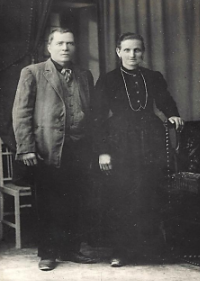
Faustino and Luisa Lucchese Guidi
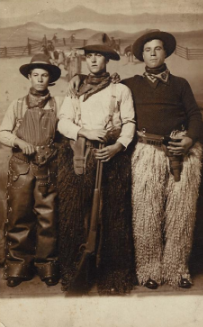
Medoro Guidi (in the center) with his friends in California
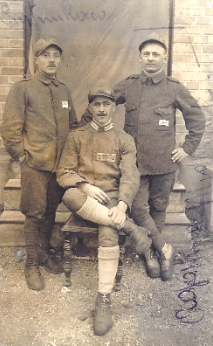
Medoro Guidi (center) and his friends from Capannori were heading to the front
Crockett welcomed the new immigrants who settled in an adjacent small village, Valona, which had grown into a neighborhood of immigrant laborers like themselves. Italians predominantly inhabited the village, along with residents from other Mediterranean countries, such as Spain, France, and Portugal. Commerce in Crockett was robust; many of the shop owners were Italian and made fresh pasta, sausages, bread, and pastries. Food, like land and housing, was abundant and affordable. Many Italians made their wine from local vineyards that grew on Valona’s steep hillsides. The climate was much like that found in their native countries, and people grew fruits and vegetables just as they had done at home in Italy. Married men sent most of their paychecks from Crockett to Italy, and Pina could see that this gave their families a sense of security, knowing that they could at least feed their children. But Pina wondered — at twenty-eight years old, how could she survive the days, weeks, months, and potentially years that Alessandro would be away from her and their children? What would the Atlantic crossing be like? Would Alessandro be safe so far from home? Alessandro couldn’t speak English! How could he ask for help?
Her mother, Luisa, who was sixty-five, had become weak in recent months. Knowing she had a large extended family and a strong support system in Italy, as well as a sister and brother-in-law in Crockett who would be near Alessandro, comforted her. Pina knew her older sister, Giuletta, now thirty-four, would help her get through this tough time. Giuletta was strong, a confidant, and a mentor, and this brought Pina relief. The Guidi sisters were also very resourceful, as their father, Fausto, had taught them to be. Giuletta, who lived nearby, had a husband, a son, and two daughters. She lived on a small farm with a few animals, and Pina knew Giuletta wouldn’t let her family starve.
To soothe herself, Pina began to think about the baby in her belly and what she might name it. As provincial Italian culture dictated at the time, her first son, Raffaello, was named for her father-in-law, Raffaello Pagni. Her second son, Faustino, was named after her father, Fausto Guidi. If her third child were a girl, she would name her Clarina, for her mother-in-law. She would have preferred to name her after her own mother, Luisa, but that was not possible in a patriarchal culture. But, if the baby were a boy, she knew exactly what she would name him – Medoro – after her dear brother, who had lost his life in World War I.
Medoro had a story worth remembering. He was a ritornato, an Italian laborer who crossed the Atlantic and returned to Italy several times. He had been working in California when World War I broke out in Europe. News of the war troubled Medoro, leaving him with a strong sense of responsibility and a duty to serve his mother country. Departing California against the advice and urging of his family and friends, who were concerned for his safety, he returned to Italy. Soon after arriving in Capannori, his hometown, he left for the front with his two friends, Augustino Migliorati and Rocco Cristini. Together, the three fought in the trenches in France, and all three were captured and sent to a German prisoner of war camp. Food was scarce in the camp, and Medoro was so hungry that he traded his pocket watch, which he had purchased in Crockett, for a sack of potato skins. Sadly, Medoro died of starvation in Mannheim, Germany, and was buried there in 1917. Migliorati and Cristini survived the camp and returned to Capannori to share their story with Medoro’s parents, Fausto and Luisa.
Upon hearing of her son Medoro’s death, Luisa slipped into deep grief and was never the same. Losing another child, especially her beloved adult son, was just too much for her to bear. Luisa had borne twelve children, but seven had died, all at different ages—Pio at six days old; Arturo at five years old; Aquilina at six; Medoro at seven; Aquilina at twelve; Arturo at nineteen; and Medoro at twenty-eight years old. Infant death was so common in rural Italy in those days that families reused their meaningful, cherished names for their children repeatedly. It is said that that’s why sopranomi, ‘nicknames’, were so common in Italy at the time.
Pina’s heart ached for her parents and her brother. It’s not easy to lose a child at any age, and she knew from the tears her mother shed every day that her mother’s heart was broken. But perhaps if she had a son, she would name him Medoro, and this would be a way for her grieving mother to find some comfort. Pina was a woman of deep faith, so to comfort herself, she began saying her Rosary, and in the wee hours of the morning, she fell back to sleep.
Pina’s baby arrives . . . . .
On May 27, 1920, with the help of an ostetrica, ‘midwife’, Pina gave birth in the upstairs bedroom she shared with Alessandro to her third son, Medoro. Faustino affectionately called his younger brother Medorino, ‘little Medoro’, until the latter died in his mid-nineties. In August 1921, just a little over two months after Medoro’s birth, Alessandro, then twenty-eight years old, left for New York and work in America. Pina would not see him again until early 1929, almost nine years later.